Sunday, June 11, 2023

Economic Moat of Airport Operators

Before we discuss airport operators, let's talk about airports themselves. Building an airport is a complex and costly undertaking, and there are many factors to consider, such as:

  •          Location, where it must accessible to the public with a possibility to expand.
  •          Runways, which must be a certain length and width and there must be enough of them to handle the anticipated traffic.
  •          Terminals to handle the passengers and cargo. It must have enough space for check-in, security, baggage handling, and boarding. It also must have enough space for taxis, car parks, and other transportation.
  •          Support facilities, like fuel storage, maintenance hangers, and air traffic control towers.
  •          Environment impact, the airport must have a minimal environmental impact. This includes minimizing noise pollution and protecting wildlife.

Building an airport is a complex and expensive undertaking.

However, it can also be a major economic driver, attracting businesses, boosting tourism, and generating foreign income.

As such, governments need to ensure that airports are operated safely, efficiently, and sustainably. Therefore, when selecting airport operators, governments will scrutinize their candidates for experience, management expertise, and commitment to safety.


Once the Airport Operator got the contract… it can be very ‘Sticky’

Once an airport operator has been in place for a while, they will have built up a "sticky" moat. This is because their employees will have learned how to make full use of the airport's layout, machinery, and other resources. They will have established a good workflow, and they will have refined it over time. This takes time and effort, and it is very difficult for a new operator to replicate.

As a result, once an airport operator has proven itself to be competent, it will be very difficult to replace them. The government will have to consider several factors before making a change, such as:

  •          Can the new operator handle a crisis?
  •          Can the new operator ensure smooth operations?
  •          Will the handover be a smooth process?

Unless the new operator can offer something significantly better than the incumbent, the government is likely to stick with the current airport operator.

Unless you are considering other modes of transportation...


Depending on the traveler's needs, flying is often the fastest way to reach a city or country. With a few exceptions, most cities only have one or two airports. This means that airports have a natural monopoly, and can charge high prices for their services. This is similar to a toll road, which is the only way to get to a certain destination.

Combo Economic Moat

Therefore an Airport Operator has a few things going in its favor that can create a wide economic moat. These include:

  •          A Natural Monopoly, there isn’t much choice available for travelers…
  •          A Toll-like business, as all travelers using the airport will have to pay certain fees…
  •          High Regulation Requirement, which creates a high barrier of entry for others
  •          High Switching Cost, as the government worries if a new operator can perform just as smoothly as the current operator.

Thus, with all these combinations, airport operators tend to gain a wide economic moat. 


With Economic Moat, does it mean it's a good business?

Despite the wide moat airport operators can have, it does not mean that they are on the road to prosperity. We still have to do our due diligence.

Therefore, I am just taking a glance at three airport operators. At the time of writing, the three with the largest market caps are:

1.       Airports of Thailand (AOT)

2.       Aena (AENA)

3.       Shanghai Airport (SHA)

I will be briefly looking at their Revenue trend, Net Income trend, and then Gross Margin.

These details will show roughly how profitable these companies are. 

AOT’s Revenue, Net Income Trend, and Gross Margin


AENA’s Revenue, Net Income Trend, and Gross Margin

SHA’s Revenue, Net Income Trend, and Gross Margin

These companies had been growing their revenue and net income for years, with gross margins consistently above 50%. However, the COVID-19 pandemic struck, and their businesses were severely disrupted.

Conclusion

I was inspired by Beansprout’s article “Airports of Thailand - Beneficiary of Thailand's tourism recovery”, https://growbeansprout.com/aot-airports-of-thailand-thai-tourism-recovery, which discusses what factors benefit AOT and what are the risks AOT may faces.

However, I still want to learn more about AOT and airport operator business in general. Thus, this motivates me to write this blog post.

I am not disappointed by this type of business. But I still have some concerns, which I have to look into it later on.

Saturday, May 20, 2023

Why I Avoid IPO

 An initial public offering (IPO) is when a company sells its shares to the public for the first time. This allows the company to raise capital and become a publicly traded company.

Usually, the purpose is to raise capital for the business.

However, IPO is something I tend to avoid.

I don’t have any advantage

As a value investor, I need to assess a company's long-term investment potential. I typically look at 10 years of financial statements to make this assessment. However, IPO companies typically only provide the latest 3 years of financial statements. While these 3 years are recent, they do not provide enough information to assess how the company has performed over time or during a crisis. This is an important factor for me to consider when making an investment decision.

Sellers have the advantage

Sellers in an IPO, such as business owners, venture capitalists, and other stakeholders, have a number of advantages. They can:

·         Set the price of the shares.

·         Determine the percentage of the company that is sold.

·         Choose the date of the IPO.

These advantages give sellers a significant amount of control over the IPO process.

As a result, it is likely that IPO shares will be sold at a premium.

There is a lot of hype generated

Brokers, capital market banks, and company stakeholders have a vested interest in generating interest, hype, and desire among the public so that they will buy shares.

The company, brokers, and investors all have a financial interest in the success of the IPO. This can create a psychological disadvantage for buyers, who may feel pressured to buy shares.

In conclusion

It is not easy to find an advantage in buying an IPO as a long-term investment. The media hype surrounding IPOs often makes it difficult to assess the true value of a company. As a result, I typically ignore the media and focus on other investment opportunities.

Thursday, April 6, 2023

What I learned from this bank run 2023

 It is really surprising for me to see a bank run at this age. I always assumed that the banking sector is safe and solid. Thanks to the regulations in place after Lehman Brothers’ demise. 


I believe by now, the current bank run and bank situation need no further explanation from me. 


But I do notice the flaws in my investing process. 


Emphasis on the numbers

As a value investor, I checked the financial statements. As they reveal the company’s financial health. 

I checked the trend of the company’s net profit, revenue, and other important information for the past few years, to check if the company is prospering. 


This information depends on the past few years' financial statements. It is important for me, as I prefer to hold the company for many years. 

If for the past few years, the company has been performing well, it MAY perform well for the next few years. 


At the time of writing, a lot of information regarding SVB Financial Group (SIVB) and Silvergate has been purged. 

But luckily I managed to find something. 

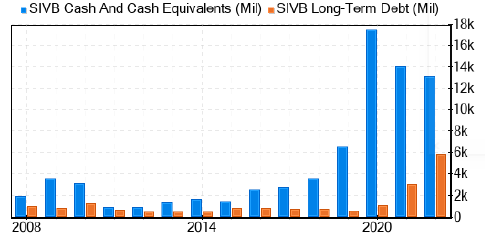
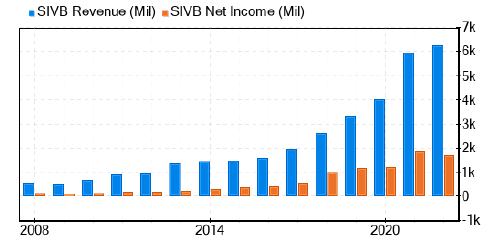
I am showing these charts to show that SIVB is indeed growing and prospering. At one point in time, the cash in hand is more than its long-term debt… 

But it still gets assassinated by the bank run. 


Therefore, using my method of just focusing on the numbers doesn’t help in filtering out a company from collapsing. 

In this bank run, once the depositors have no faith in the bank, the bank will just fail and collapse. It's profitability and hard work in the past have no meaning. 


In short, checking on the financial statement and looking at its trend does not help against the bank run. 


What can help me improve my investment process?


Big Four gets the money

Based on this article, “https://seekingalpha.com/article/4587688-bank-stock-panic-5-attractive-buys-that-could-benefit”. The Big Four, JP Morgan, Bank of America, Citigroup, and Wells Fargo have been benefitting from this situation. 

However, No bank can survive a bank run, no matter how big the bank is. 


Yet, depositors still put their money with them. 


Why?


Reputation has an effect (Economic Moat?)

I had a chat with my non-investment-savvy friend regarding this bank run. I have forgotten how the discussion went but somehow I did mention that if given a choice, which company will I invest in Singapore if I am given only 1 choice? 


Without doubt and hesitation, I will pick DBS. 


“Government mah” is my friend's remark on my choice. 


His remark shows light on my above question regarding depositors going to Big Four. 


DBS needs no introduction, but a brief background, DBS was set up to improve Singapore’s economic development by the Singapore Government. 

Thanks to this history, and the Singapore Government’s reputation, Singaporeans have a lot of faith and trust in our Government to make things work. 


I'm pretty sure he didn’t check how much net profit DBS has, and the amount of cash it has, and compared them with OCBC and UOB. 

I am sure he didn’t do a series of due diligence to check if DBS is a prospering and good company. 


Yet, we come to an agreement that DBS is a good company. 

All he needs to know is that DBS is from the Singapore Government, it is safe. Short and Sweet. 


This could be the case of the bank run and the Big Four’s unexpected benefits. 


Thanks to their reputation and branding, they gained more deposits, allowing them to make more loans or investments. 


Humble Pie to Eat

So I am wrong. Reputation and branding matter. Especially in times of faith and confidence are tested. 


However… this leads to a new question…


How do I assess a company’s reputation? 

Hmm…


Disclaimer: I do own Bank of America and OCBC Shares. 

Tuesday, January 17, 2023

My Takeaway from Economists The World Ahead 2023

I bought 'The World Ahead' yearly, hoping to have some idea of what may happen in the coming year. Here are my takeaways from this edition.

Energy

There are so many things that we need electricity for.

Nations, including Singapore, that can't produce the fuel for it will have to import them and will be at the mercy of the market price.

Thanks to the Russia and Ukraine war, oil and gas price rocketed & some nations have little choice but to refire their coal power plants, some even use their nuclear power plants.


A blow to climate change efforts.

But some countries benefitted from this war, as they have a good relationship with Russia. Russia can sell its oil & gas to these friendly countries at a cheaper rate while these countries can either use them or resell them.


To top it off, renewable energy isn't going to replace fossil fuels fast anytime soon.


Yes, there are a lot of countries aggressively developing infrastructure and investing in technology to green our electricity needs. But it isn't going to replace all the fossil fuel consumption in a short period.


In short, we still need fossil fuels for the time being.

And those oil and gas companies, I am sure they will have some business in the meantime.

Semiconductor industry

Countries realize the importance of semiconductors. Semiconductors are necessary for communications devices, high-tech weapons like missiles, infrastructure management, and many more.

It is hard to say what areas in our lives have no impact despite our technological progression.


However, many of the semiconductor components are imported. This means the supply chain of 

Semiconductors are vulnerable and fragile. A disruption may hurt a nation's technological improvement.


Governments around the world are well aware of this problem. And they are building their in-country manufacturing Semiconductor companies, or becoming a major shareholder of the existing ones in their country.


This most likely helps these companies to grow, as the governments most likely award contracts to their home-grown companies.


This also means it is very hard for these companies to expand to other countries. Thus, another Natural Monopoly will happen, and this time, it will be within each country, with its homegrown semiconductor companies.


But how long will it take to achieve this state? I am not sure. Is it a good thing?


I believe so, as each country is aiming to be technologically superior over the others, be it for economical or military purposes, they will research, hire the best talents in the field, nurture their own citizens' children to be in that field, or attract foreign talent (I know, a sensitive topic) to their country to work on this.


So it is good overall.


Countries building up their semiconductor Manufacturing capabilities, making them resilient to supply chain disruption. This also results in creating a high demand for jobs; a reliable income for these companies and spurs innovation greatly. Of course, these companies will get the bulk of their revenue from their native country. Expansion from overseas may be tough, but not impossible.


Therefore these Native semiconductors will have an economic moat within their country. Those international semiconductor companies may see their economic moat erode due to their ‘forces’.


However, how fast will these happen? I am not so sure… but definitely not in the current and near future. 

Land, Properties, and Infrastructure

I believe that Land developers may have a harsh time soon. Thanks to inflation.

Why?


The construction sector required a lot of manpower.

Inflation will cause the workers to demand a higher salary.

So will the cost of building materials and related expenses.


If the construction company has yet to collect money from their prospective buyers, naturally they can raise their prices and check the demand and cater accordingly.


But what if the money was collected but the project has yet to start or is in the midst of construction?


The project may not be profitable due to inflation, and the weaker developers may have to make tough decisions.


I suggest taking a very close look at their respective balance sheet if planning to buy any construction companies.


Developers aren't the only ones facing problems. Home sales, mortgage lending, and house prices may suffer due to higher interest rates. Sellers and lenders may have a hard time finding customers & borrowers.


Despite the gloom, the USA still has housing shortages; 3.8 million citizens do not own a house. Though the demand is there, I am just not sure in the near future, what will happen to these companies.


Well… a wise guy told me… the best way to get out of trouble is to stay away from trouble.

Unless I am confident and sure of the company’s economic prosperity, looking elsewhere isn’t a bad choice. 

Saturday, January 7, 2023

McDonald's Corporation’s Economic Moat

McDonald's Corporation (ticker: MCD) needs very little introduction. The company was founded in 1940 by two brothers, Richard and Maurice McDonald, and it has since grown to become one of the most recognized and successful brands in the world. MCD operates more than 38,000 restaurants in more than 100 countries, and it serves millions of customers every day, making it difficult to rival its reach.

Brand and Customer Loyalty

I am sure this is a common scene. When children pass by one of MCD’s restaurants and see its golden arch, they most likely pester their parents to go in and eat something. Not only that, if a person is in a foreign land, if he isn’t comfortable eating the local food, he might opt to eat at an international brand restaurant. If there is an MCD nearby and he may choose to eat there.

The loyalty of its customer is strong that when MCD leave Russia because of the war, one man handcuffed himself to one of the restaurants hoping that MCD wouldn’t leave Russia. I wish I made it up, but this one of the news reporting: https://www.mirror.co.uk/news/world-news/russian-mcdonalds-fan-chains-himself-26458955

The MCD’s brand is one of the most recognized and trusted brands in the world and this helps the company to attract and retain customers. When people think of fast food, burgers, or French fries, they often think of MCD, and this strong association has helped the company to build a loyal customer base that returns to its restaurants time and time again.

In addition, the MCD’s brand is associated with a high level of quality and consistency, which helps to further build customer loyalty and trust. This creates a strong intangible asset for the company and helps it to maintain its competitive advantage in the fast food industry.

Established Global Supply Chain

A global supply chain is a network of organizations involved in the production, handling, and distribution of goods and services from raw materials to end customers. The goal of a global supply chain is to maximize efficiency and minimize cost by coordinating the flow of materials, information, and capital across the various stages of production, distribution, and consumption. For example, getting the raw food from farmers, processing the food, and then selling it in restaurants.

McDonald's global supply chain helps the company to keep costs down in several ways. This isn’t an easy feat, due to the sheer number of restaurants this company has. Not to mention it is one of the largest numbers of restaurants in the world, based on https://www.alltopeverything.com/largest-fast-food-restaurant-chains/

First, the company has a large and diverse network of suppliers that allows it to take advantage of economies of scale and negotiate favorable prices for raw materials and other inputs. Suppliers love to receive bulk orders. Raw food is perishable, time isn’t in their favor. Thus, if their customers, like MCD, place a huge order, they will gladly give them a better price. It saves them the headache of storing or disposing of the food. Either way, there are costs involved.

Second, MCD has developed strong relationships with its suppliers over the years, which helps it to secure reliable and consistent supplies of high-quality ingredients at competitive prices. If their suppliers know what MCD wants, and their standards for their ingredients, and they deliver what MCD wants consistently, MCD most likely be their regular customer.

Finally, MCD invests in logistics technologies and inventory management systems to optimize its supply chain operations and minimize waste, which helps to keep costs down. This helps MCD to increase the efficiency and effectiveness of its global supply chain, which is an important factor in the company's ability to keep costs low in the long run.

Franchises

MCD operates a large network of franchises, which is a strong part of its business model and a pillar of its success.

A franchise is a business arrangement in which a company (the franchisor) grants the right to use its name, products, and operating system to another company (the franchisee) in exchange for a fee.

MCD has a franchise model for many of its restaurants, which means that the company sells the right to use its brand and operating system to independent business owners (franchisees) who operate McDonald's restaurants in their local markets.

This franchise model has several benefits for MCD.

First, it allows the company to expand its operations and reach a wider market without incurring the full costs of owning and operating all of its restaurants.

Second, it enables MCD to tap into the local knowledge and expertise of its franchisees, which are often well-connected and deeply embedded in their communities. One such example is that in 2013, MCD in China put rice products on their menu. The core reason is that the Chinese consider a meal without rice is not a complete meal.

MCD helps its franchisees in a few ways too.

First, the company provides training and resources to help franchisees get started and operate their restaurants effectively. This may include training in areas such as food safety, customer service, and management, as well as access to tools and resources such as marketing materials and operational guidelines. Second, McDonald's offers ongoing support to its franchisees to help them maintain high standards of quality and service and stay up to date with the latest products and practices. This may include training programs, marketing support, and technical assistance. Finally, McDonald's provides financial and logistical support to its franchisees through its supply chain and purchasing programs, which help to keep costs low and ensure a consistent supply of high-quality ingredients and other supplies. This creates a win-win situation for both MCD and its franchisees.

Therefore the franchise model helps McDonald's to build a strong and loyal network of business owners who are invested in the success of the company and committed to upholding its standards of quality and service.

Conclusion

McDonald's Corporation has several economic moats, including strong brand recognition and customer loyalty, a large and well-established network of franchises, and a global supply chain that helps it to keep costs low. In addition, MCD has a diversified menu and a focus on innovation, which allows it to appeal to a wide range of customers and stay relevant in an increasingly competitive marketplace. These factors help McDonald's to maintain its position as one of the most successful fast food chains in the world.


For a glance at MCD, please have a look over here: https://drive.google.com/file/d/15mBUGNRujk-4zwuDJlyxckGZOyjal2k9/view?usp=share_link


Sunday, January 1, 2023

Google's Economic Moats

Economic Moat allows the company to keep its competitors at bay from taking its business & profitability.

Google is one of the most successful company will most likely have some advantages to maintain or even grow further its profitability.

 Here are some examples. 

Brand

I am sure at some point in our life we will use this phrase, " I google it". The activity of searching and researching something has become a simple word, 'google'.

How did it happen? To be honest, although Google was created in my lifetime, I can't recall why this phrase happens.

Despite the start of the internet, there were a few search engine websites. I even remembered watching Yahoo! advertisements on television, trying to create an impression on the public.

Yet, it becomes a verb in our language. Thus, Google has become an action word and also the search engine to use.

This makes Google the most visited website in the world. Followed by Youtube, which is also owned by Google. 

Source: https://www.semrush.com/website/top/

Android: Budget smartphones

Apple and Android are sharing the smartphone market share. Apple has a 27% market share while Android has almost 72% market share globally.


Source: https://gs.statcounter.com/os-market-share/mobile/worldwide


Despite Apple having a smaller market share, it does have larger revenue. Android, on the other hand, licenses its OS to phone manufacturers globally, which helps them save the time, effort, and cost of developing one. Then these phone manufacturers passed these savings to their customers, making Android phones very affordable for the public.

Google can charge a fee from these phones via Google Play. Google Play provides an easy distribution channel for Android users and app developers.

Thus Google created not only a low-cost moat for phone users, and also a distribution network for app developers to sell their apps.

Data Moat

Thanks to its search engine and YouTube, along with other services. Google can collect an extensive amount of data.

However, being able to collect a lot of data does not create a moat for the company.

A company needs to make sense of the data collected, also known as insight.

And to be able to get such insight, require analytic capability.

The better the analytic capability, the better the insights, and the company will be able to produce a better product.

This new product will bring in new customers & generate, not only new revenue, new data for the company to further improve or make new or better products. And also improving the existing products. This virtuous cycle builds up and repeats itself.

Google can achieve that thanks to the first-mover advantage it has in search engines. It is also able to analyze the data it has able get useful insights so that it can produce new products or improve the products or services it already has. 

Conclusion

Economic moats are a sign of a great company.

Google's economic moats create a virtuous cycle for Google to improve and create wonderful products and services. This makes Google very sticky to its users and customers.

For consumers like me who will keep using Google services like its search engine, YouTube, Google Docs, and Sheets. Not only they are free, but they also make good suggestions. I will most likely keep using them until those services don't work.

Thus, thanks to this ‘stickiness’, business owners will post advertisements on Google, hoping to improve their business income.

For a glance at Google’s profitability, please have a look at this pdf: https://drive.google.com/file/d/1xqJ0A4dxN0cxCIbR22awZIl3baJ4kLpf/view


Wednesday, December 21, 2022

Bank of New York’s Economic Moat

Bank of New York (ticker: BK) is a custodian bank.

A custodian bank is a specialized financial institution responsible for providing securities services. It safeguards the assets of investors, usually asset managers, insurance companies, and/or hedge funds, and is not engaged in "traditional" commercial or consumer/retail banking like lending money to clients to buy properties.

Being the Biggest with a cost advantage

BK is the world’s largest custodian bank with nearly $47 trillion in assets under custody and/or administration (AUC/A); while the next biggest custodian, State Street, has $43.7 trillion in assets. As one of the largest financial institutions in the world, it has a significant customer base and a strong presence in various markets around the globe. This gives BK the ability to offer a wide range of financial products and services to its clients, which can be difficult for smaller competitors to match.

They also clear about $10 trillion of securities and process over $2 trillion of payments per day, and manage $2.4 trillion of assets on behalf of their Investment and Wealth Management clients.

Why do these matter?

This can allow the company to offer competitive pricing to its clients, which can be a barrier to entry for smaller competitors.

High Switching Cost

A high switching-cost moat exists when the customer faces significant costs in the process of switching from one service provider to another. The costs may be in the form of cash, time, and the discomfort of using the new service provider.

For a financial institution like BK, switching costs can be a significant barrier to entry for competitors and can help to protect the bank's market share and profitability. Some of the potential switching costs for customers of BK may include:

·         Fees for closing accounts or transferring funds: Customers may incur fees if they want to close their accounts or transfer their funds to a different bank. These fees can be a deterrent for customers considering a switch.

·         The inconvenience of switching: Switching banks can be a time-consuming and inconvenient process, especially for customers with multiple accounts or a large number of transactions. This can make it less likely for customers to switch banks, even if they are unhappy with the service they are receiving.

·         Loss of rewards or benefits: Some customers may be hesitant to switch banks if they have built up rewards or benefits, such as points or cash back, through their current bank. These rewards and benefits can be significant incentives for customers to stay with their current bank.

Overall, the switching costs for customers of BK may be a factor that helps to protect the bank's market share and profitability, as it can make it more difficult for customers to switch to a different financial institution.

Economies of Scale

As this bank serves 35 countries and more than 100 markets, it can act as a single point of contact for clients who may be looking to trade, manage funds, make transactions, or restructure investments.

This gives BK the ability to serve a diverse range of clients, including corporations, governments, and financial institutions.

BK’s global presence allows the bank to offer a wide range of financial products and services to its clients, including investment management, asset servicing, and securities lending. The bank's international network also allows it to provide clients with access to a range of currencies and financial markets, which can be particularly beneficial for clients with cross-border needs.

In addition to its global reach, BK also has a long history and a strong reputation for stability and reliability. This can give the bank an advantage in attracting and retaining customers, as well as in attracting and retaining top talent.

Overall, BK’s presence in so many countries and markets is a significant advantage that helps to differentiate the bank from its competitors and allows it to serve a diverse range of clients around the world.

Summary

The Bank of New York is a large financial institution with several competitive advantages that help it to protect its market share and profitability. These advantages include a cost advantage due to its size and scale, high switching costs for customers, and economies of scale that allow BK to benefit from lower costs and more efficient operations.

Together, these factors contribute to BK’s economic moat in the financial services industry and help to protect its market share and profitability over time.


Here is a quick glance at the Bank of New York's financials.


December is the month of reflection 2024

Stonks! Seriously… this year has been stonking for a lot of markets. At the start, the Japanese market rallied after decades of bad performa...