Saturday, January 7, 2023

McDonald's Corporation’s Economic Moat

McDonald's Corporation (ticker: MCD) needs very little introduction. The company was founded in 1940 by two brothers, Richard and Maurice McDonald, and it has since grown to become one of the most recognized and successful brands in the world. MCD operates more than 38,000 restaurants in more than 100 countries, and it serves millions of customers every day, making it difficult to rival its reach.

Brand and Customer Loyalty

I am sure this is a common scene. When children pass by one of MCD’s restaurants and see its golden arch, they most likely pester their parents to go in and eat something. Not only that, if a person is in a foreign land, if he isn’t comfortable eating the local food, he might opt to eat at an international brand restaurant. If there is an MCD nearby and he may choose to eat there.

The loyalty of its customer is strong that when MCD leave Russia because of the war, one man handcuffed himself to one of the restaurants hoping that MCD wouldn’t leave Russia. I wish I made it up, but this one of the news reporting: https://www.mirror.co.uk/news/world-news/russian-mcdonalds-fan-chains-himself-26458955

The MCD’s brand is one of the most recognized and trusted brands in the world and this helps the company to attract and retain customers. When people think of fast food, burgers, or French fries, they often think of MCD, and this strong association has helped the company to build a loyal customer base that returns to its restaurants time and time again.

In addition, the MCD’s brand is associated with a high level of quality and consistency, which helps to further build customer loyalty and trust. This creates a strong intangible asset for the company and helps it to maintain its competitive advantage in the fast food industry.

Established Global Supply Chain

A global supply chain is a network of organizations involved in the production, handling, and distribution of goods and services from raw materials to end customers. The goal of a global supply chain is to maximize efficiency and minimize cost by coordinating the flow of materials, information, and capital across the various stages of production, distribution, and consumption. For example, getting the raw food from farmers, processing the food, and then selling it in restaurants.

McDonald's global supply chain helps the company to keep costs down in several ways. This isn’t an easy feat, due to the sheer number of restaurants this company has. Not to mention it is one of the largest numbers of restaurants in the world, based on https://www.alltopeverything.com/largest-fast-food-restaurant-chains/

First, the company has a large and diverse network of suppliers that allows it to take advantage of economies of scale and negotiate favorable prices for raw materials and other inputs. Suppliers love to receive bulk orders. Raw food is perishable, time isn’t in their favor. Thus, if their customers, like MCD, place a huge order, they will gladly give them a better price. It saves them the headache of storing or disposing of the food. Either way, there are costs involved.

Second, MCD has developed strong relationships with its suppliers over the years, which helps it to secure reliable and consistent supplies of high-quality ingredients at competitive prices. If their suppliers know what MCD wants, and their standards for their ingredients, and they deliver what MCD wants consistently, MCD most likely be their regular customer.

Finally, MCD invests in logistics technologies and inventory management systems to optimize its supply chain operations and minimize waste, which helps to keep costs down. This helps MCD to increase the efficiency and effectiveness of its global supply chain, which is an important factor in the company's ability to keep costs low in the long run.

Franchises

MCD operates a large network of franchises, which is a strong part of its business model and a pillar of its success.

A franchise is a business arrangement in which a company (the franchisor) grants the right to use its name, products, and operating system to another company (the franchisee) in exchange for a fee.

MCD has a franchise model for many of its restaurants, which means that the company sells the right to use its brand and operating system to independent business owners (franchisees) who operate McDonald's restaurants in their local markets.

This franchise model has several benefits for MCD.

First, it allows the company to expand its operations and reach a wider market without incurring the full costs of owning and operating all of its restaurants.

Second, it enables MCD to tap into the local knowledge and expertise of its franchisees, which are often well-connected and deeply embedded in their communities. One such example is that in 2013, MCD in China put rice products on their menu. The core reason is that the Chinese consider a meal without rice is not a complete meal.

MCD helps its franchisees in a few ways too.

First, the company provides training and resources to help franchisees get started and operate their restaurants effectively. This may include training in areas such as food safety, customer service, and management, as well as access to tools and resources such as marketing materials and operational guidelines. Second, McDonald's offers ongoing support to its franchisees to help them maintain high standards of quality and service and stay up to date with the latest products and practices. This may include training programs, marketing support, and technical assistance. Finally, McDonald's provides financial and logistical support to its franchisees through its supply chain and purchasing programs, which help to keep costs low and ensure a consistent supply of high-quality ingredients and other supplies. This creates a win-win situation for both MCD and its franchisees.

Therefore the franchise model helps McDonald's to build a strong and loyal network of business owners who are invested in the success of the company and committed to upholding its standards of quality and service.

Conclusion

McDonald's Corporation has several economic moats, including strong brand recognition and customer loyalty, a large and well-established network of franchises, and a global supply chain that helps it to keep costs low. In addition, MCD has a diversified menu and a focus on innovation, which allows it to appeal to a wide range of customers and stay relevant in an increasingly competitive marketplace. These factors help McDonald's to maintain its position as one of the most successful fast food chains in the world.


For a glance at MCD, please have a look over here: https://drive.google.com/file/d/15mBUGNRujk-4zwuDJlyxckGZOyjal2k9/view?usp=share_link


Sunday, January 1, 2023

Google's Economic Moats

Economic Moat allows the company to keep its competitors at bay from taking its business & profitability.

Google is one of the most successful company will most likely have some advantages to maintain or even grow further its profitability.

 Here are some examples. 

Brand

I am sure at some point in our life we will use this phrase, " I google it". The activity of searching and researching something has become a simple word, 'google'.

How did it happen? To be honest, although Google was created in my lifetime, I can't recall why this phrase happens.

Despite the start of the internet, there were a few search engine websites. I even remembered watching Yahoo! advertisements on television, trying to create an impression on the public.

Yet, it becomes a verb in our language. Thus, Google has become an action word and also the search engine to use.

This makes Google the most visited website in the world. Followed by Youtube, which is also owned by Google. 

Source: https://www.semrush.com/website/top/

Android: Budget smartphones

Apple and Android are sharing the smartphone market share. Apple has a 27% market share while Android has almost 72% market share globally.


Source: https://gs.statcounter.com/os-market-share/mobile/worldwide


Despite Apple having a smaller market share, it does have larger revenue. Android, on the other hand, licenses its OS to phone manufacturers globally, which helps them save the time, effort, and cost of developing one. Then these phone manufacturers passed these savings to their customers, making Android phones very affordable for the public.

Google can charge a fee from these phones via Google Play. Google Play provides an easy distribution channel for Android users and app developers.

Thus Google created not only a low-cost moat for phone users, and also a distribution network for app developers to sell their apps.

Data Moat

Thanks to its search engine and YouTube, along with other services. Google can collect an extensive amount of data.

However, being able to collect a lot of data does not create a moat for the company.

A company needs to make sense of the data collected, also known as insight.

And to be able to get such insight, require analytic capability.

The better the analytic capability, the better the insights, and the company will be able to produce a better product.

This new product will bring in new customers & generate, not only new revenue, new data for the company to further improve or make new or better products. And also improving the existing products. This virtuous cycle builds up and repeats itself.

Google can achieve that thanks to the first-mover advantage it has in search engines. It is also able to analyze the data it has able get useful insights so that it can produce new products or improve the products or services it already has. 

Conclusion

Economic moats are a sign of a great company.

Google's economic moats create a virtuous cycle for Google to improve and create wonderful products and services. This makes Google very sticky to its users and customers.

For consumers like me who will keep using Google services like its search engine, YouTube, Google Docs, and Sheets. Not only they are free, but they also make good suggestions. I will most likely keep using them until those services don't work.

Thus, thanks to this ‘stickiness’, business owners will post advertisements on Google, hoping to improve their business income.

For a glance at Google’s profitability, please have a look at this pdf: https://drive.google.com/file/d/1xqJ0A4dxN0cxCIbR22awZIl3baJ4kLpf/view


Wednesday, December 21, 2022

Bank of New York’s Economic Moat

Bank of New York (ticker: BK) is a custodian bank.

A custodian bank is a specialized financial institution responsible for providing securities services. It safeguards the assets of investors, usually asset managers, insurance companies, and/or hedge funds, and is not engaged in "traditional" commercial or consumer/retail banking like lending money to clients to buy properties.

Being the Biggest with a cost advantage

BK is the world’s largest custodian bank with nearly $47 trillion in assets under custody and/or administration (AUC/A); while the next biggest custodian, State Street, has $43.7 trillion in assets. As one of the largest financial institutions in the world, it has a significant customer base and a strong presence in various markets around the globe. This gives BK the ability to offer a wide range of financial products and services to its clients, which can be difficult for smaller competitors to match.

They also clear about $10 trillion of securities and process over $2 trillion of payments per day, and manage $2.4 trillion of assets on behalf of their Investment and Wealth Management clients.

Why do these matter?

This can allow the company to offer competitive pricing to its clients, which can be a barrier to entry for smaller competitors.

High Switching Cost

A high switching-cost moat exists when the customer faces significant costs in the process of switching from one service provider to another. The costs may be in the form of cash, time, and the discomfort of using the new service provider.

For a financial institution like BK, switching costs can be a significant barrier to entry for competitors and can help to protect the bank's market share and profitability. Some of the potential switching costs for customers of BK may include:

·         Fees for closing accounts or transferring funds: Customers may incur fees if they want to close their accounts or transfer their funds to a different bank. These fees can be a deterrent for customers considering a switch.

·         The inconvenience of switching: Switching banks can be a time-consuming and inconvenient process, especially for customers with multiple accounts or a large number of transactions. This can make it less likely for customers to switch banks, even if they are unhappy with the service they are receiving.

·         Loss of rewards or benefits: Some customers may be hesitant to switch banks if they have built up rewards or benefits, such as points or cash back, through their current bank. These rewards and benefits can be significant incentives for customers to stay with their current bank.

Overall, the switching costs for customers of BK may be a factor that helps to protect the bank's market share and profitability, as it can make it more difficult for customers to switch to a different financial institution.

Economies of Scale

As this bank serves 35 countries and more than 100 markets, it can act as a single point of contact for clients who may be looking to trade, manage funds, make transactions, or restructure investments.

This gives BK the ability to serve a diverse range of clients, including corporations, governments, and financial institutions.

BK’s global presence allows the bank to offer a wide range of financial products and services to its clients, including investment management, asset servicing, and securities lending. The bank's international network also allows it to provide clients with access to a range of currencies and financial markets, which can be particularly beneficial for clients with cross-border needs.

In addition to its global reach, BK also has a long history and a strong reputation for stability and reliability. This can give the bank an advantage in attracting and retaining customers, as well as in attracting and retaining top talent.

Overall, BK’s presence in so many countries and markets is a significant advantage that helps to differentiate the bank from its competitors and allows it to serve a diverse range of clients around the world.

Summary

The Bank of New York is a large financial institution with several competitive advantages that help it to protect its market share and profitability. These advantages include a cost advantage due to its size and scale, high switching costs for customers, and economies of scale that allow BK to benefit from lower costs and more efficient operations.

Together, these factors contribute to BK’s economic moat in the financial services industry and help to protect its market share and profitability over time.


Here is a quick glance at the Bank of New York's financials.


Sunday, December 11, 2022

December is the month of Reflection 2022

Crypto Winter

Crypto, stocks & α lot of asset prices dropped since the start of the year. The main culprit is USA's interest rates. It creates a negative spiral effect across the markets & capital flight to the reserve currency's bonds.

If it is just the crypto prices drop, that's fine. As the customers can cut their losses and withdraw their reminding money. As it turns out there are a lot of cans of worms opened... As these exchanges use their clients’ money or crypto for their own speculative or investment purposes. When their clients want to withdraw their money or crypto, these exchanges can't do so. They freeze the withdrawal function & shortly these exchanges declare bankruptcy. While their clients have nothing left.

I admit not all exchanges have the same problems. However, they did not live up to their promise, allowing the clients to trade & withdraw their money/crypto.

To add, some of these exchanges use this money, to buy luxury assets (Good Class Bungalow, yachts, etc)!  I can't be sure what money they use to buy but when the exchange bankrupt, the liquidators also take these assets. So I guess they are using companies’ assets to buy these luxury assets.

Reflecting on this, without regulation, will we humans do anything right? Or is regulation really necessary so that people like these will not abuse these privileges?

Even if there are such self-disciplined people in Management roles, how many will there be?

To prevent such things from happening regulations will be in place. But when this happens, Taxation will & will be no different from a normal financial market. Something the crypto surely doesn't want.

Interest rate is the gravity


When Warren Buffett said interest rate is gravity. I have yet to fully understand what he means by Until now… (I think)

When interest rates are low, the market is willing to buy more risky assets for better returns than near-zero interest-rate bonds, which are nearly risk-free. When these safest assets become more profitable, everything else drops in price and keeps chasing & people the safest assets. REITs aren’t spared as investors are worried the cost of debt increases which may cause REITS to produce lesser dividends.

Maybe I put it this way. The interest rate is similar to a planet’s gravity. And the asset’s price is like a rocket that is trying to reach to the moon. The stronger (higher) the gravity (interest rate), the harder the rocket (asset’s price) to take off. And vice versa. The weaker (lower) the gravity (interest rate) is, the easier for the rocket (asset’s price) to soar.

Thus, the interest rate is like gravity! I guess it took a war and untold suffering in other countries for me to realize this. And I hope I got it somewhat right.

Regulations too strict backfired too!


China was the first to discover Covid 19. Their Swift response helped them save as many lives as possible back then. As time passed, medical science managed to make the covid 19 vaccine in the shortest possible time. This is a great achievement! This allows other nations to lower their covid restriction earlier, while china insists only to use their homemade vaccines. However, for some reasons that elude me, China is not able to achieve the ideal vaccination rates & infection rates plus death work are soaring.

Thus, this leaves China to carry on imposing strict Covid measures. Although their intent is truly wished to protect their citizens, this comes with a lot of negative effects. Supply chain disruption, causes inflation to rise. The elderly were suffering great inconvenience. And lastly, the one that trigger the latest protest, was a fire that broke out which killed everyone in a building when they can't escape due to the covid restrictions.

Yes, protests happened. Now the China government is willing to relax the restriction.

Regulations are necessary. Yet, if the regulations are too strict... It doesn't benefit anyone either. Making the balance is a tough thing to do.

My take here isn’t a criticism of the China Government’s policy. But I am reflecting that regulations are important, but being too strict with them will create tragedy too.

Portfolio Management


Risk is always present in any investment. No matter how sure I am in my investment. Of course, certain investments are so safe that I don't mind allocating a big bet in my portfolio.

Even Warren Buffett can get it wrong sometimes. And on the recent local example, Temasek Holdings write off F1X investment.

Despite the amount of money, they invested in FTX in terms of millions that amount is less than 1% of their total portfolio. Plus they look 8 months to do their due diligence.

8 months! Temasek Holdings should be able to have Superior data, tools & connections to make a better-informed decision.

Yet they can still make a loss. What are my odds? I have to respect the risk. Sooner or later this will happen to me. And if since it is going to happen, I believe that I should invest conservatively.

December is the Month of Reflection.

I believe this year has a lot of suffering and a lot of losses.

But I am still grateful for my situation now. Still grateful that I still have a roof, am well-fed & have a simple job. No one is shooting at me; the one who wants to take away my home.

Something this money can't buy. Peace of mind is truly priceless.

You’re Humility

Manferd

Wednesday, October 26, 2022

When and where to use the Price to book value ratio as a valuation?

 My friend in telegram asked me the title question. For him, I derived two answers, hard and easy answers.

Hard Answer

When it comes to valuating a business, there are 2 areas of consideration:

1.       What does the business own?

2.       How much the business does is earning?

However, in this blog sharing, I wouldn’t be sharing on pointer 2. Thus… let’s start with pointer 1.

What does the business own

Assuming there are 3 companies:

1.       Company (A) has Singapore Treasury Bonds (rating: AAA), Investment properties that generate Rental income, and some companies’ shares

2.       Company (B) has quite a lot of stationary inventory and some machinery like photocopy machines and binding machines.

3.       Company (C) has groceries inventory both fresh and non-fresh, for example, fresh fish, meat, vegetable, and canned and frozen food. It also has some machinery to help its employees with their operations, for example, trolleys, meat-slicing machines, etc.

Just looking at these companies and their assets alone, which do you prefer to invest in?

For me, I will prefer to invest in (A). As these assets can sell almost at their face value or even if I don’t sell them, the assets will automatically generate passive income for me.

It isn’t fair to say that (B) and (C) aren’t good businesses. But there are more factors for me to consider determining that. For example, location, how often their inventory turnover is, and how fast, in particular for (C) thanks to their fresh groceries inventory.

If you look in another way, some of the (C)’s assets do not have the luxury of time, and (B) and (C) required me to operate the business to ensure sales and income. While (A) most likely does not require me to be this active.

Thus, if a company has similar assets in its balance sheet like (A). The Price to book value (PB) ratio may be a good idea to use as a gauge.

Usually, when I research the company, I will look at what business it is doing, what assets do its own, how much percentage of its assets is high quality (for example, AAA bonds, investment properties, cash), and how much is book value per share.

So let’s assume that (A)’s book value per share is $100. The asset allocation is 45% AAA bonds, 45% investment properties, and 10% other companies' shares. If the price for (A) share is $50, making the PB ratio 0.5, this might be a good investment opportunity. This gives investors a chance to buy the company for less than what the company paid for those assets.

Of course, there are other factors to consider, but this is a simple example to valuate a business using PB.

In short, the hard answer to my friend’s question is:

Depends on the assets the company owns. The more valuable the asset the company owns, PB seems to make sense.

Easy Answer

So what is the easy answer? In very simple terms, Banks, Insurance companies, and REITs are great usual suspects. As they usually have assets that generate income for the companies.

Banks have loans that generate interest income. Insurance companies usually buy high-quality bonds to earn interest. REITs have properties to earn rental income.

And usually, their allocation for these types of assets is a pretty high percentage in their balance sheet. 

Friday, June 17, 2022

Why Share Repurchase Matters?

I remembered watching a TED video about James Randi about homeopathy. On stage, he swallowed a whole bottle of sleeping pills. However, the pills are much more diluted than the actual medicine, and even ingesting the whole bottle of pills does not have any fatal consequences.

You can watch that TED video here: https://youtu.be/c0Z7KeNCi7g

The company’s shares can have the same effect. If the company keeps issuing new shares, this will dilute the net profit that each share provides.

As such, I will prefer to the company does the opposite; reduce the number of outstanding shares. Thus each share will get a large net profit in the future. This is usually called share repurchase or share buyback.

Benefits

Like eating medicine or supplement, we are expecting some form of benefits for our health. There are benefits to share repurchase for the shareholders.

Can only be done by using Cash

A company that generates a lot of cash can do a lot of things to improve its business or it can return value to its shareholders.

A dividend is the most direct and tangible way to provide value to the shareholders.

Share repurchase is another way to return value to their shareholders too, but it isn’t so directly.

Regardless, to buy back their shares from the open market, they have to use cash.

In this case, how they get their cash is important. I will look out at their operating cash flow and their free cash flow. If the company has a lot of operating cash flow and free cash flow, this means the company’s core operations are generating cash for the company.

There are other ways to generate cash, for example, borrowings or raising more capital by issuing more shares. These methods of generating cash aren’t sustainable in the long run.

Improving the Metric

This is kind of technical. Let’s imagine a company has the following:

·         1000 shares outstanding

·         Net profit $1000 for the year 2000

As such the Earnings per share (EPS) for the year 2000 is $1 (Net profit $1000 / 1000 share outstanding)

Then in 2001, this happened:

·         900 shares outstanding

o   The company brought back 100 shares with cash

·         Net profit $1000 still for the year 2001

Then in 2001, their EPS will become $1.11 (Net profit $1000 / 900 shares outstanding)

Despite the net profit does not increase from the year 2000 to 2001. However, the EPS has improved simply because the company brought its shares back.

This affects Return on Equity (ROE) and Return on Asset (ROA) metric too.

Investors use these metrics, EPS, ROE, and ROA to evaluate the company.

Compounding Effect

The previous section demonstrates how buying shares improved the metrics like EPS.

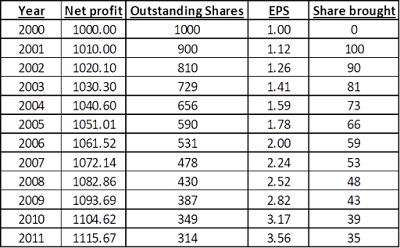
Let’s see what will happen if the company keeps doing that over a few years. The table below shows that if the company keeps buying at 10% of the outstanding shares.


Assuming that the net profit does not increase over the years, just decreasing the outstanding shares improved the EPS over the years.

If the company can prosper and increase its net profit, the effect of compounding is more potent. The below shows that if the company manages to increase its net profit yearly just by 1%.


This shows that as long as the shareholder keep holding on to their shares, the shares will be more valuable in the future.

Scarcity

As the company buys back its shares, there is a lesser amount of shares in the open market.

This means that whoever keeps holding on to the shares will have a larger percentage of ownership of the company.

Usually, if there are lesser sellers in the market, the buyers will have to buy at a higher price for the share. As the demand is higher than the supply, the price of the share may rise.

Shareholders don’t have to pay a cent!

The company will buy back its shares with the company’s cash. The shareholders are not required to pay for this action.

That being said, that doesn’t mean this action is free, just that the company is paying for it, reducing their cash for shares.

Tax?

As the company buyback their share, it isn’t a payment to the shareholders, unlike a dividend. As a Singaporean Investor in USA-listed companies, the dividend is taxable. At the time of writing (17/6/2022), there is a 30% withholding tax on my USA company's dividends.

Which isn’t an income to the shareholder; as such there isn’t a tax on it.

Drawbacks

Although supplements are good for health, overconsuming certain vitamins may have negative health outcomes.

Similarly, companies can benefit from buying back their shares. But it isn’t an action that can be used every time and in every situation. There are drawbacks if the company applied share repurchase inefficiently.

Can only be done by using Cash

If the company is unable to generate excess cash, it may not consider this action. Improving their business operation should be their focus.

If the company uses loans to buy back its shares, I probably have to listen carefully to its rationale. This course of action is usually considered unwise. If I am not satisfied with the reason, I will skip this company.

Not at any Price

The company will benefit more if it buys the share at an undervalued price.

However when comes to intrinsic value, it can be subjective. As everyone values the same investment differently.

As such, if the company management is ridiculously optimistic about their company share, they may just buy the shares recklessly.

This may reduce the efficiency of their money.

For example:

A company has allocated $ 1 million to buy back its shares.

That company’s Book Value per share is $100 per share. For simplicity’s sake, let’s take that as the company’s intrinsic value.

It also has 10 million outstanding shares.

Assuming the company’s net profit is $10 million.

As such, depends on the Price to Book (PB) value the company brought the shares:


As such, the table shows that as best as possible, if the company can buy their shares as cheap as possible, they can buy more shares back. The effects of their share buyback will be more effective on the EPS.

As such, it isn’t a good idea to just buy the shares at any price. Buying it cheap against the intrinsic value is more efficient.

However, there is more than 1 way to valuate a company. If the management wants to buy the shares back, they can easily justify with a very optimistic valuation and then buy back the shares.

Summary

The share buyback is a good sign for the company in general. The company must have the cash to buy back shares. If the company is generating a lot of cash from its operations, this can compound to those shareholders who still holding on to their shares.

What price does the company buy is the issue. However, even if the company pays a high price for its shares, it is still in favor of the shareholders. Just that it isn’t that efficient.

As best as possible, the company should buy its shares back as cheaply as possible. Of course, life isn’t as smooth as we wish to be. We can only prepare for the good and bad things to come. 

Sunday, June 5, 2022

Taking a Peek at Utility

I am taking a peek at Utilities Companies in USA and Singapore.

Why so? It isn’t going to grow or prosper like those sexy tech companies. Nor does it have the hype either. Unless Elon Musk tweets about those companies out of the blue.

But in theory, at least some people believe that the Utility sector has some advantages:

·         A defensive sector

·         Produce goods and services with inelastic demand

However, because of the Utilities’ characteristics, they do have some problems:

·         Very heavily regulated

·         Very Capital intensive

Defensive Sector

In theory, the Utility sector underperformed when the market rallies. However, when the market falls, the Utility sector remains relatively resilient.

From Gurufocus, this is the overall performance for the past 10 years. VOO is the ETF for S&P500, while VPU is the ETF for the Utility sector.  


How do I know if this theory is true or otherwise?

Maybe I just need to look at the recent months. Thanks to the Fed’s rising interest rates, the overall market share price is dropping.


Well… looks like the Utility sector (VPU) doesn’t fall as much compared to S&P 500’s VOO.

What about a rally?

I am using 1/1/2020 to 1/1/2021, a recent rally and it does show that while VOO is improving by 51%, VPU was only 18%.

Although I only did a comparison for the recent times, it does seem Utility is kind of resilient.

Inelastic demand for their products and services

What is Inelastic demand?

It is when the demand or consumption of a certain product or service remains relatively the same even when the price has increased.

For example, 30 eggs were priced at $6.50 back in Feb 2022. However, in April 2022, it has become $7.05. But customers still bought relatively the same amount of eggs daily. (At least for me though.)

Although in May 2022, some supermarkets' 30 eggs prices had gone down to $6.75, I still consumed roughly the same amount of eggs monthly.

Thus, my demand for eggs is pretty inelastic.

The Utility sector products and services have similar characteristics. They provide electricity, gas, and water. Not only are they difficult to give up, but they are extremely difficult to adjust our consumption without resulting a big impact on our daily life.

Very Heavily Regulated

Because the Utility’s products and services are inelastic, in economic terms. This results in 3 important implications.

Not sensitive to income growth or economic activity

Usually, when the public becomes wealthier, they may indulge more. For example, dine out in the restaurant more often, or buy the latest luxury watch.

The utility may not able to enjoy a lot of this additional spending from their customers. Drinking more water probably is the last thing in their mind when they strike a lottery.

Vice versa, if the public received a pay cut, they may spend less. Instead of dining out, they may cook at home, which is cheaper. However, the utility may not suffer a huge reduction in their customer demand. The customers may consume lesser, but there is a level of consumption needed to maintain their basic needs.

Thanks to this factor, the Utility sector is relatively resilient during an economic downturn.

Natural Monopoly

Utilities are a fine example of a natural monopoly.

Natural monopolies can appear when one company is much more efficient than other competitors in providing the goods or services to the market. Even without unfair business practices that company will over time become a monopoly due to the market conditions.

This may happen in two ways:

1.       The company takes advantage of the industry’s high barrier to entry, thus creating a “moat” around its business operations. One example is the high cost involved. A water utility needs a lot of machinery, and a pipe network, to satisfy the water safety requirement set by the government and hire a large number of specialists, engineers, and technicians.

2.       The company is producing at a scale so large that it is so much more efficient than small-scale production. And that company satisfies all the available market demand. Thus, the small-scale producers can’t compete due to cost.

Utilities tend to be a natural monopoly thanks to the high cost involved and it doesn’t make sense to have another company compete against it. Sooner or later, one company will remain either the competitor bankrupt, give up or merge with a superior company.

Regulations

As Utilities will naturally become a monopoly, they may abuse their unique position and may raise prices without control. Thus, the government will have to step in to ensure there is no such abuse. As Utilities are essential, almost irreplaceable, and vital to the economy, as this gives the government a very strong reason to regulate them. To ensure the utilities are reliable, cost-effective, and still affordable enough for everyone.

But are Utility companies good?

Whether a company is good is subjective. However, in my case, I look for a company that can is it:

·         Profitable?

·         Good cash flow generation?

·         Able to grow?

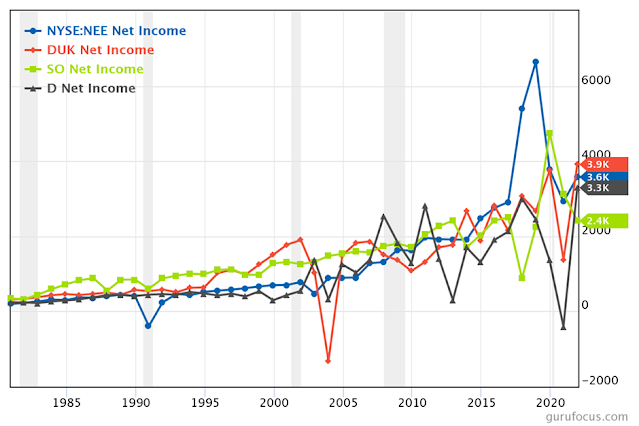
I take references from the utilities in the USA first. And let’s see if we can find any patterns. Sadly, there are too many utilities listed in the USA, I just use the top 4 market cap and see if I can learn anything from it.


In this case, I will be looking at NextEra Energy (NEE), Duke Energy (DUK), Southern Co (SO), and Dominion Energy (D).

USA Utilities: Profitability?


The overall trend looks like the companies are growing their revenue.


But their net profit doesn’t grow as much as their revenue. But profitable MOST of the time.

USA Utilities: Cash Flow?

Looking into their cash flow from operations can give us an idea of how much cash it generates from their operations.


Most of the time they are generating an increasing flow of cash into the companies.


However, their free cash flow is another story… as Free cash flow is the reminding cash after cash flow from operations deduct from capital expenditures, this shows that to remain in business, utilities need to re-invest themselves. Re-invest itself… Heavily. 

USA Utilities: Growing?

This is a bit tricky… what metrics show that the company is growing?

Maybe let’s look at their cash.


The result is a kind of mix, SO’s cash is growing over time. D’s cash is maintained at a certain range. But overall, most of their cash has wide volatility.

Let’s look at other areas, like their property, plant and equipment. They need these to provide their utility service to the public. 


Well… this assets liner is increasing over time. Generally speaking for all the companies.

Retained Earnings are another way to check whether the company is growing.


Looks like only NEE has a good growth in its retained earnings. While the others are still growing, but not as explosive as NEE.

Singapore Utilities


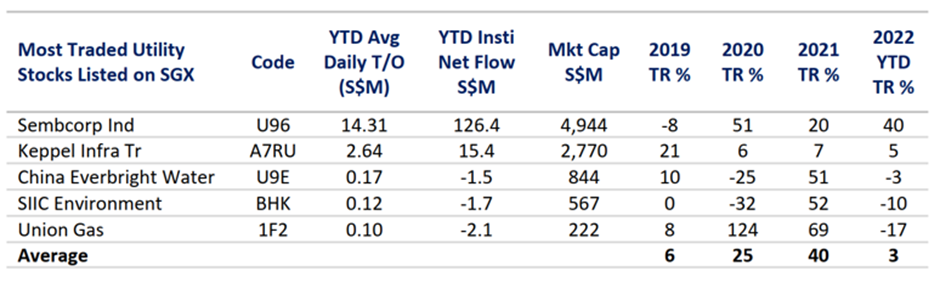
Philip Securities newsletter email has sent me some suggestions, I will be looking at SembCorp Industries Limited (U96), Keppel Infrastructure Trust (A7RU), China Everbright Water Ltd (U9E), SIIC Environment Holdings Ltd (BHK), and lastly Union Gas Holdings Ltd (1F2).

Now in Singapore, let’s see if we can find any insights. Same as the USA’s Utilities, I will be looking at their profitability, cash flow and whether can they grow.

I will be showing 1 chart with all 5 Singapore utility companies, and 1 chart without Sembcorp Ind (U96). The reason is that I would like to compare all of these companies together, but U96’s data is larger than the other companies, which distorts the chart for the other 4 utility companies. So I will show another chart without U96 to have a better view of the other companies.

Singapore Utilities: Profitability?

Let’s look at their Revenue first.


While Sembcorp (U96) has had huge swings in its revenue over the years, it is the largest out of the 5.

Apart from Union Gas (1F2) seems to grow its revenue the slowest. Otherwise, the rest seems to be quite ok. They can grow their revenue.


Although U96 has the biggest revenue, its net profit doesn’t seem to match its revenue size and suffer a loss in the year 2020. Keppel Infrastructure Trust (A7RU) has also suffered losses in the recent 2 years too.  Otherwise, these companies usually are profitable.

Singapore Utilities: Cash Flow?


Unable to see a clear pattern, but there are times some companies will have negative cash flow from their operations.


Their free cash flows show a similar pattern as their operating cash flow.

Singapore Utilities: Growing?

Again, let’s have a look at the cash


While U96 has the most amount of cash, the rest of the companies (most of them actually) manage to increase their cash in hand.


All of them increased their property, plant and equipment, but U96 and A7RU increased their property, plant and equipment more than the rest.


Only BHK’s retained earnings are performing well. A7RU is getting worse and worse. Weird… A7RU is profitable but its retained earnings aren’t accumulating.

Observation

Singapore Utilities and USA Utilities are different.

USA Utilities are performing in their operating cash flow, able to invest in themselves and grow their retained earnings.

Singapore Utilities, although their operating cash flow isn’t consistent, can increase their cash in hand. They do invest in themselves, but their retained earnings aren’t that consistent.


Well… recently I learned that, if it isn’t obvious then stay away.

I guess for Singapore Utilities, I probably stay away. It isn’t obvious to me that these companies are prospering.

But for the USA Utilities, there are more than what I just found. Maybe I can spare some time to search for some interesting companies that might be worthy of deeper research.

Your Humility,
Manferd


December is the month of reflection 2024

Stonks! Seriously… this year has been stonking for a lot of markets. At the start, the Japanese market rallied after decades of bad performa...